
The RBI's mistake may have been in interpreting its mandate to maintain retail inflation at 4%, with 2% leeway in either direction, as being a mandate that permitted it to do nothing even when inflation was at or near the upper bound of 6%, observes T N Ninan.

The agency had in May projected an economic growth between 7.7 and 8 per cent for this fiscal and Monday's revision comes within a week of rival Fitch Ratings, and Citigroup revising the same to 7.5 per cent from 7.7.

Indian economy to grow at 5.5 per cent in near term.

If the current restrictions remain in place until the end of May, we estimate that the cumulative loss of activity could amount to around $10.5 billion, or around 0.34 percentage point (pp) of annual nominal gross domestic product, say Barclays economists.

India will also play an increasingly important role as one of the Asia-Pacific region's major economic growth engines, helping to drive Asian regional trade and investment flows.
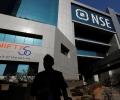
BofA Securities has revised its year-end Nifty target from its earlier projection of 16,000 to 14,500 now - down over 6 per cent from the current levels. Fast tightening monetary conditions, slowing growth/fears of US recession and the likely Nifty EPS (earnings per share) cuts, BofA Securities said, are the key headwinds for the markets in the near-term. However, clarity on macro and monetary policy outlook in the US/India, it said, is the silver lining that could see markets bottom out by August/September 2022.

With improved prospects for the farm sector, Centre for Monitoring Indian Economy on Friday raised the economic growth forecast for 2005-06 to 6.8 per cent from the earlier six per cent.
The US has slipped into a recession and is estimated to shrink 2.6 per cent in the fourth quarter, primarily stoked by worsening credit conditions, says a survey.

Tata Steel was the top gainer in the Sensex pack, rallying 3.23 per cent, followed by SBI, Yes Bank, Hero MotoCorp, ICICI Bank and Bharti Airtel.
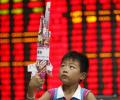
Some analysts argue that Beijing has been too cautious in lowering rates and freeing up cash in the banking system, keeping real interest rates too high given low returns on investment.

The economic impact of the Omicron variant of COVID-19 on emerging economies will depend on a mix of government restrictions, public comfort with social interactions, and capacity of governments and central banks to provide additional policy support to the private sector, Moody's Investors Service said on Wednesday. The emergence of the new variant poses new risks to the global economic growth and inflation outlook, as concerns mount about the variant's health risks and several countries have imposed new travel restrictions in recent days. These restrictions will likely increase over the coming weeks until scientists learn more about the variant, it said.

Besides Surat, which will also be the world's fastest growing city during 2019-35, the other nine cities are Agra, Bengaluru Hyderabad, Nagpur, Tiruppur, Rajkot, Tiruchirappalli, Chennai and Vijayawada.
India's gross domestic product grew by 4.8 per cent in July-September quarter of 2013-14 as against 5.2 per cent in same period of previous fiscal.
As the Ukraine conflict impacts the global GDP, India is projected to grow by 6.4 per cent in 2022, slower than the last year's 8.8 per cent but still the fastest-growing major economy, with higher inflationary pressures and uneven recovery of the labour market curbing private consumption and investment, according to a UN report. The UN Department of Economic and Social Affairs said in its World Economic Situation and Prospects (WESP) report released on Wednesday that the war in Ukraine has upended the fragile economic recovery from the pandemic, triggering a devastating humanitarian crisis in Europe, increasing food and commodity prices and globally exacerbating inflationary pressures. The global economy is now projected to grow by only 3.1 per cent in 2022, down from the 4.0 per cent growth forecast released in January 2022.

It had upped India's rating to Baa2 from Baa3 and changed its rating outlook to 'stable' from 'positive', saying the reforms would help stabilise rising levels of debt.

RE of GDP for 2015-16 show that the economy grew 7.9% in 2015-16, rather than the earlier estimate of 7.6 per cent.

The RBI has set up a panel to review ATM charges, and fees levied by banks.
Growth in South Asia this year is forecast to be 7 per cent slightly, up from the 6.9 per cent recorded for 2003, the Asia Development Bank said on Wednesday.

If the fiscal deficit for the year can be maintained at Rs 7.04 trillion, the deficit as a percentage of GDP will slip to 3.44 per cent

Rajan also said weak results from India's corporate suggested final demand is yet to pick up strongly.

Monsoon is likely to be below normal in the current year at 93%.

Stressing that economic growth will only move upwards, the Reserve Bank of India Governor Shaktikanta Das on Friday pegged the GDP growth rate for the next financial year at 10.5 per cent, though a tad lower than the government's projection of 11 per cent. The projection is in line with the estimates in the Union Budget 2021-22 presented in Parliament earlier this week. The Economic Survey, tabled by the government in Parliament recently, has projected that the economy will grow at 11 per cent, up from an estimated historic decline of 7.7 per cent in 2020-21, on account of the COVID-19 pandemic.

Stating that COVID-19 has not yet been contained in India, the rating agency in a statement said the government stimulus package is low relative to countries with similar economic impacts from the pandemic. "The COVID-19 outbreak in India and two months of lockdown -- longer in some areas -- have led to a sudden stop in the economy. That means growth will contract sharply this fiscal year (April 2020 to March 2021)," it said. "Economic activity will face ongoing disruption over the next year as the country transitions to a post-COVID-19 world."
Hurt by a contraction in mining and manufacturing.
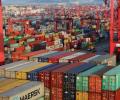
Exports in June rose by 23.52 per cent to $40.13 billion while the trade deficit ballooned to a record level of $26.18 billion mainly due to jump in gold and crude oil imports, the government data said on Thursday. The country's export growth in May was 20.55 per cent. Imports expanded by 57.55 per cent to $66.31 billion in June compared to the year-ago month, the data showed.

The Indian economy, severely hit by the coronavirus pandemic, is projected to contract by a massive 10.3 per cent this year, the International Monetary Fund said on Tuesday. However, India is likely to bounce back with an impressive 8.8 per cent growth rate in 2021, thus regaining the position of the fastest growing emerging economy, surpassing China's projected growth rate of 8.2 per cent, the IMF said in its latest 'World Economic Outlook' report.

India's growth in the last three financial years has averaged just 1.9%. It is natural to project rapid growth from this low base. Crucial to that would be the assumption that the economy has suffered no lasting damage from the pandemic, observes T N Ninan.
Chief Economic Adviser K V Subramanian on Wednesday said India is expected to hit a growth rate of 6.5-7 per cent in 2022-23 and accelerate further to 8 per cent in the subsequent years on the back of reforms undertaken by the government. He also said the government is expected to meet the fiscal deficit target of 6.8 per cent in the current fiscal despite pressure on revenue collections.

India's economy, estimated to contract by 6.9 per cent in 2020 due to the coronavirus pandemic, is forecast to record a "stronger recovery" in 2021 and grow by 5 per cent, according to a UN report which said the country's current fiscal year budget points to a shift towards demand-side stimulus, with an uptick in public investment. The report, 'Out of the frying pan ...Into the fire?' published Thursday as an update to the Trade and Development Report 2020 by UN Conference on Trade and Development (UNCTAD) said the global economy is set to grow by 4.7 per cent this year, faster than the 4.3 per cent predicted in September 2020, thanks in part to a stronger recovery in the US, where progress in distributing vaccines and a fresh fiscal stimulus of $1.9 trillion are expected to boost consumer spending.

The rupee depreciated 6 paise to 77.50 against the US dollar in the opening trade on Wednesday as a surging American currency in the overseas markets and persistent foreign fund outflows weighed on investor sentiment. Besides, rising global crude prices impacted the domestic unit, forex traders said. However, a higher opening in the domestic equity market restricted the rupee's fall, they added.

A day after global brokerage firm Macquarie painted a rosy picture of the Indian economy and raised its target level for the stock indices for the next 12 months, Goldman Sachs said India is set to overtake China and become the fastest-growing emerging market during 2016-18.
Describing the recent two consecutive spikes in retail inflation beyond the 6 per cent as a 'transitory hump', a Wall Street brokerage on Monday said it expects the RBI to overlook it and unanimously stick to the dovish stance at the forthcoming policy review, even though a further upward revision of its already-revised inflation target is more likely. The Reserve Bank-led monetary policy panel is scheduled to announce the third monetary policy review on August 6, amidst the continuing spike in retail inflation that has breached the 6 per cent upper tolerance level for the past two consecutive months.

In rupee terms, India's market cap is currently about Rs 184 trillion - 90 per cent of the GDP of Rs 203 trillion for FY20 at current prices.
Economic think-tank NCAER has revised its projections for economic growth to 7.9 per cent for 2006-07, compared to 7.7 per cent made in April due to likely higher growth in industry and services sectors.
India's economy is unlikely to see double-digit growth and may grow between 8 per cent and 9 per cent this fiscal year (2021-22, or FY22), against the estimated 11.5 per cent, according to leading economists and rating agencies. The downward revision of growth projections to as low as 10 per cent is mostly on account of stringency in restrictions by states, relatively slow vaccination pace, and the possibility of a third wave of the pandemic. However, they say the impact will not be as severe as the first wave, and expect the first quarter to see positive growth.

Growth in emerging market and developing economies will slow to 4.4 per cent in 2014, before rising to 5.0 per cent in 2015, it said.

The Reserve Bank on Wednesday hiked key benchmark policy rate by 25 basis points to 6.5 per cent, citing sticky core inflation. This is the sixth time interest rate has been hiked by the Reserve Bank of India (RBI) since May last year, taking the total quantum of hike to 250 basis points. Announcing the bi-monthly monetary policy, RBI Governor Shaktikanta Das said the Monetary Policy Committee (MPC) by a majority decided to raise the policy repo rate by 25 basis points and keep a 'strong vigil' on inflation outlook.

A bit of economic reforms stalled and decisions delayed -- what Narayana Murthy spoke of -- don't hurt if a country's compassionate and inclusive social fabric has survived intact; if the country is happy, observes Shyam G Menon.

ICICI Bank was the top gainer in the Sensex pack, rising around 3 per cent, followed by Axis Bank, HDFC twins, SBI, L&T, ONGC and Infosys. On the other hand, Sun Pharma, Asian Paints, Nestle India, UltraTech Cement and HUL declined. NSE Nifty rose by 79.60 points or 0.67 per cent to 11,914.20.
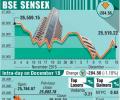
The S&P BSE Sensex lost 285 points to end at 25,519.
